

As we look forward to 2026, the year promises to be one of both challenge and opportunity, with national reviews about leadership and structure underway. EMPAC has a track record of unwavering agility to both move with the times and influence the future proactively through dynamic research insight. At the outset of a new year, whilst our future oriented mission continues, we take stock of our journey so far: there is much impact already and more to be built upon.
Home Office funding
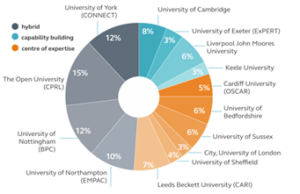
It is ten years since the Home Office, via the College of Policing, alongside the then Higher Education Funding Council (HEFCE), invested the largest amount ever into policing research. £10 million was made available under the Police Knowledge Fund (PKF) to UK competitive bidders, based on merit. EMPAC won 10% of that overall budget, just behind the University of York, the Open University and the University of Nottingham. EMPAC’s was a hybrid bid comprising a collaborative framework integrating an entire police region (five police forces) and coterminous universities.
Productivity
The PKF was about building sustained capability within policing to understand, critique and use research embed or accelerate understanding of crime and policing issues to invest in greater innovation and accelerate knowledge exchange and translation. EMPAC, then hosted at Northampton on behalf of the region, was the most productive of any of the PKF winners, delivering 19 research projects across a range of priority areas including cyber, vulnerability and community policing with evidence used to support policy and practice decisions.
Findings from new research led to changes in local force operational models, resource allocation to police activities and informed decisions about operating models and approaches to service delivery (College of Policing, 2018: 26). There has been ongoing work to improve performance reduce demand failure, co-ordinated at the regional level – keep an eye out for the EMPAC newsfeed for more detail.
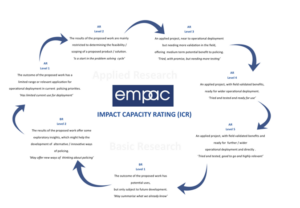
EMPAC’s Impact Capacity Model was widely adopted, informed by operational police commander real-world needs to ensure future research could be practically usable and hit the ground running (College of Policing, 2018: 32). This was adapted for a policing purpose from the Frascati Manual, the definitive methodological reference tool for university research worldwide, being promoted by the Organisation for Economic Co-operation and Development (OECD), based in Paris, across its 38 members states. For more detail see: EMPAC’s Research Impact tool attracts growing interest – EMPAC home page.
EMPAC enabled 30 Fellowship-based research projects for existing police officers and staff, gnerating both new knowledge whilst also embedding internal long-term CPD via the use of accredited programmes for enhanced in-house specialist skills. Several of those EMPAC Fellows contributed to the European Society of Criminology and continued with their research and studies, progressing into doctoral studies. See some of our Fellows talk about their work and how research can make a real-world difference to policy and practice here: Spotlight on EMPAC Fellows – EMPAC home page & Practitioner research – EMPAC home page.

Global insight, locally applied
EMPAC’s regional focus, using the best of global insight, for local application, inspired others and is increasingly relevant given structural police changes afoot. EMPAC’s story to date was told in Professors Steven Tong and Denise Martin’s 2023 book An Introduction to Police Research, published by Routledge, being the inspiration behind the All Wales Police Academic Collaboration (AWPAC).
‘Global insight applied locally’ has manifested itself in several ways for EMPAC. For example, local research about reducing post prison release recidivism, utilised not only local but also international experts from the USA to ensure the best ideas and insights were translated to our regional context. See the full story and read the evaluation report here: Leicestershire Police leading the way in reducing offending – EMPAC home page.
National and international expertise
Experts from Australia were brought to the region to coach police commanders in the use of restorative practice Transforming Policing using a Restorative Framework, 28th September – EMPAC home page. Professor Lawrence Sherman brought leading insights about EBP in the USA to a national conference hosted by EMPAC at Northampton EMPAC hosts SEBP Conference 2017 – EMPAC home page.
EMPAC hosted the National Police Chief’s Council (NPCC) national portfolios of Rural Crime DMU host EMPAC Rural Crime Roundtable, 7th November 2018 – EMPAC home page and Serious Organised Crime at De Montfort University and convened discrete national work on Analytics at the East Midlands Special Operations Unit.
Industrial innovation
Given the region has a long history of industrial innovation, right back to the industrial revolution, it’s hardly surprising that our ideas have been promoted by EMPAC further afield, presenting in Vancouver (Exploring Intelligence Driven Policing – EMPAC home page), Chicago (Talking Police Education at the American Society of Criminology, Chicago – EMPAC home page), and Dubai (Policing 5.0 – EMPAC home page) on a number of research updates originating from the EMPAC’s regional enterprise zone.
EMPAC’s reputation, punching at a global as well as regional level, has contributed to much national work too, such as the Strategic Review of Policing EMPAC works with the Police Foundation on the Strategic Review of Policing – EMPAC home page and evaluating the Home Office’s Clear Hold Build strategy and the NPCC’s Uplift efforts.
EMPAC has presented at over 50 national conferences on a variety of topics, ranging from knife crime, cyber security, crime prevention, counter terrorism through to anti-social behaviour; the next conference is on organised crime businesses in February 2026 https://www.publicpolicyexchange.co.uk/event.php?eventUID=QB19-PPE .
Future-oriented research
As well as evaluating several regional initiatives to ensure best value in the here and now, EMPAC is promoting key research drivers Think OCB not OCG and Solution Oriented Practice, to offer incredible transformational change opportunities for the decade ahead in policing policy and practice.
EMPAC’s has been a remarkable story of evolution which continues to accelerate its efforts to capture learning insights from today yet also shape the policing future of tomorrow. You can keep up to date with our latest ventures here: Research Roundup: a one minute briefing – EMPAC home page
Comments